Post Image
Image
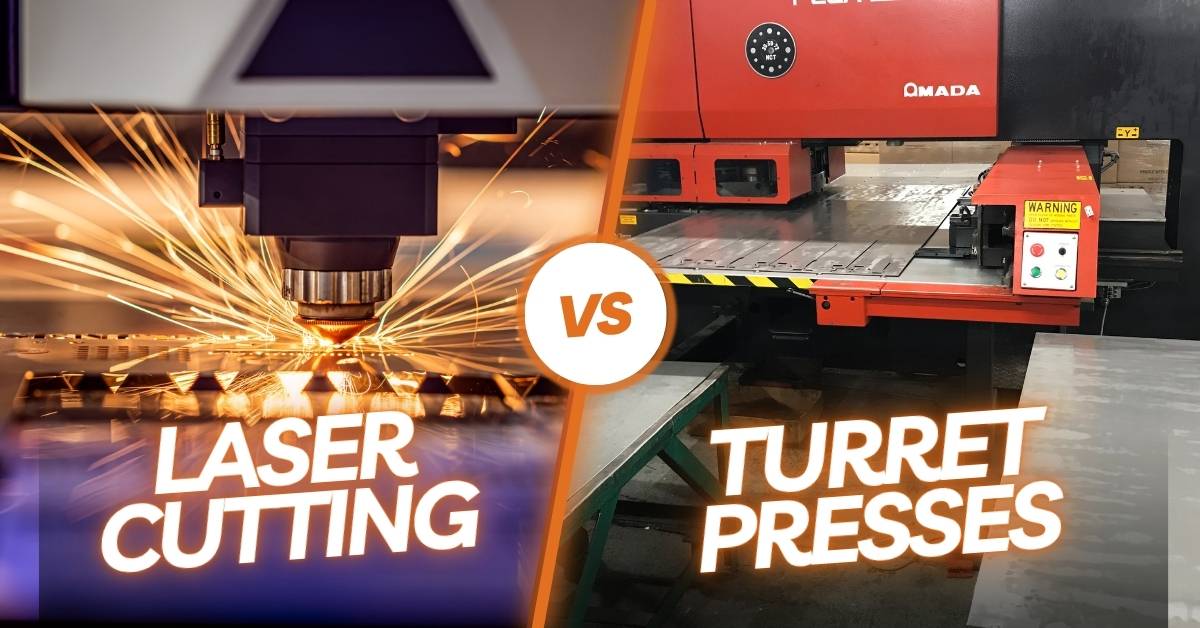
Choosing between laser cutting and turret punching can influence the cost, quality, and production speed of a sheet metal part. Both processes produce accurate, repeatable components, but they achieve those results in different ways.
The right choice in the laser cutting vs. turret punching comparison depends on your material, part design, production volume, and secondary requirements. The answer is not always cut-and-dried. One process may be the obvious choice, while other projects require a closer look at the complete production plan.
How Does Laser Cutting Work?
Laser cutting uses a concentrated beam of energy to cut a programmed shape from sheet metal. Because the cutting path is controlled digitally, a laser can move between straight lines, curves, holes, and slots without changing physical tools.
Modern fiber lasers combine speed with high accuracy across a wide range of materials and thicknesses. They are helpful for parts with profiles or designs that may change during development.
Laser cutting offers many advantages, including:
- No dedicated cutting tool is required
- Complex shapes can be produced
- Narrow kerfs support efficient material utilization
- Design changes can often be made by updating the program
- Automated systems can support repeat and high-volume production
- Smooth, consistent edges can reduce secondary processing
These benefits make laser cutting a flexible choice for custom blanks, brackets, panels, enclosure components, guards, and many other fabricated products. When a design needs intricate cuts or frequent revisions, the laser is often ready to assume the spotlight.
How Does Turret Punching Work?
A CNC turret press uses interchangeable tooling to punch features into sheet metal. The turret holds a selection of punches and dies that rotate into position as the sheet moves through the machine.
Standard tools can quickly produce common holes, slots, notches, and other repeatable features. When the right tooling is available, a turret press may also create formed features such as knockouts, louvers, embossments, or countersinks during punching.
Turret punching can provide advantages such as:
- Fast production of repeated holes and standard features
- Good for medium- and high-volume parts
- The ability to create certain formed features
- Consistent results across repeat production runs
- It's economical when suitable tooling is already available
- Works with precoated or printed materials in appropriate applications
Turret presses are especially valuable when a design includes many repeated features or can benefit from punching and forming operations within the same setup. Given the right application, a turret press can really punch above its weight!
Which Process Is Better for Design Changes?
Laser cutting is typically more adaptable when a product is still evolving. Changing a hole location or adjusting an outside profile may only require a programming update, provided the revised design remains compatible with the material and equipment.
Turret punching may also accommodate design changes, especially when the revised part uses existing tools. However, a change that includes a nonstandard feature could require different or custom tooling.
This does not mean turret punching lacks flexibility. AMF maintains seven turret presses and a broad range of tooling to support varied part designs. The key question is whether an existing tool can produce the required feature efficiently.
Which Is Better for High-Volume Production?
Production quantity matters, but volume alone does not determine the answer.
Turret punching can be highly economical for repeat parts that use standard tools. Once the program and tooling arrangement are established, the machine can rapidly produce repeated holes and features throughout large quantities.
Automated laser-cutting systems are also well suited for high-volume production. Their cutting speed, material-handling automation, and lights-out capabilities make it possible to produce parts efficiently.
For a high-volume project, the comparison should consider more than machine cycle time. Setup, material utilization, tooling, secondary operations, part handling, and downstream forming all affect the total cost.
How Material and Finish Affect the Decision
Material type and thickness can change which process is most practical. Laser cutting works with carbon steel, stainless steel, aluminum, and several nonferrous metals across a broad thickness range. Laser power, assist gas, desired edge quality, along with material properties all influence processing.
Turret presses are commonly used for sheet metal applications in which the material thickness and required features match the available punch-and-die combinations.
The existing finish also matters. Precoated, printed, or lithographed material may require special handling to protect its appearance. A mechanical punching process can be advantageous for certain finished materials because it does not introduce a laser's concentrated heat along the cut. However, tooling contact and surface protection must still be evaluated.
AMF's engineering team reviews the complete application rather than making a recommendation based on material alone.
When Should You Choose Laser Cutting?
Laser cutting may be the better option when your part includes:
- Complex or irregular profiles
- Curves and nonstandard openings
- Frequent engineering revisions
- Low initial quantities or prototype requirements
- Thicker material within the laser's capacity
- A need to avoid dedicated cutting tools
- Nested components designed to maximize sheet utilization
It is also a strong option when edge quality and design flexibility are major priorities.
When Should You Choose Turret Punching?
Turret punching may be the better option when your part includes:
- Numerous repeated holes or slots
- Standard features that match existing tooling
- Knockouts, louvers, or other formed features
- Medium- or high-volume repeat production
- Precoated or printed sheet metal
The savings become more meaningful when the turret can complete features that would otherwise require additional operations.
The Best Process May Use Both Technologies
Laser cutting and turret punching are not competing technologies in every situation. They are complementary tools, and some projects may benefit from both.
A project may use turret-punched material before laser cutting separates more detailed profiles. Another design may be evaluated on both processes to determine which route provides the best balance of speed, material use, edge quality, and cost.
That is why production planning should begin before a part reaches the shop floor. A design that initially appears ideal for one machine may become more economical after a small adjustment to its holes, corners, or formed features.
Is there a winner in the Laser Cutting vs Turret Punching Debate
There is no universal winner in the laser cutting vs. turret punching decision. Laser cutting provides design flexibility, quick programming changes, and the ability to cut through varied materials. Turret punching excels at rapidly producing repeat features and may add formed details during the same operation.
Accurate Metal Fabricating operates advanced laser-cutting systems and seven CNC turret presses, giving our engineers the flexibility to recommend the process that fits the part. We evaluate the design, material, quantity, tolerances, finish requirements, and downstream operations before developing a production plan.
If you are deciding between laser cutting and turret punching for an upcoming project, send us your drawings and production requirements. Our team can review the application, weigh the options, and help ensure your project makes the cut.